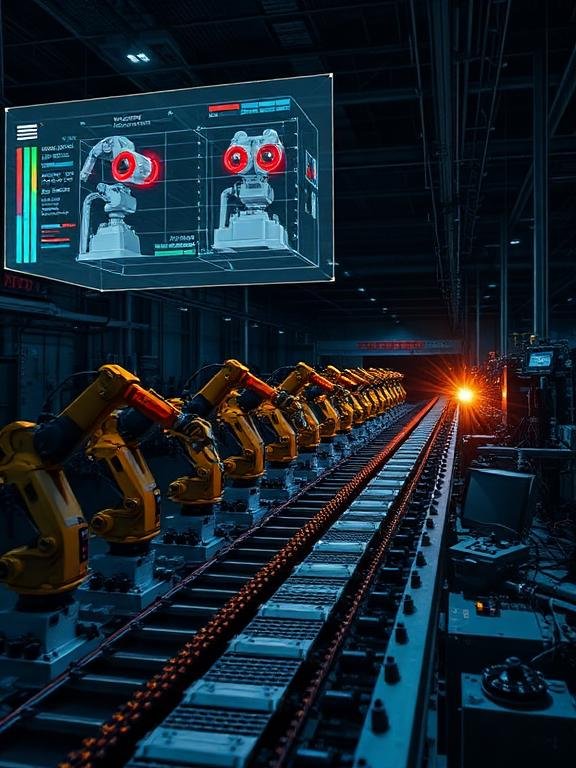
Smart factory AI
Transform manufacturing operations with predictive maintenance, computer vision quality inspection, digital twins, and AI-optimized production scheduling. From shop floor to supply chain.
The intelligent factory is here
AI in manufacturing encompasses predictive maintenance systems, automated quality inspection, digital twins, supply chain optimization, and production scheduling intelligence that reduce unplanned downtime by 45% while improving first-pass yield rates and overall equipment effectiveness.
Our Manufacturing AI Platform transforms this data into operational intelligence. Predictive maintenance prevents unplanned downtime, computer vision automates quality inspection, and digital twins enable simulation-based optimization.
From discrete manufacturing to process industries — AI solutions that connect to existing PLC/SCADA systems, MES platforms, and ERP environments without disrupting production.
AI for the modern factory
From equipment health to finished goods quality — intelligence everywhere.
Predictive Maintenance
Vibration analysis, thermal patterns, and electrical signatures predict failures 30-90 days in advance. Reduce unplanned downtime by 45% with condition-based maintenance.
Quality AI
Computer vision inspection at line speed — defect detection, dimensional verification, and surface quality assessment. Replace manual sampling with 100% automated inspection.
Supply Chain AI
Demand sensing, supplier risk monitoring, inventory optimization, and logistics planning. End-to-end visibility from raw materials to finished goods delivery.
Digital Twin
Virtual replicas of production lines, equipment, and processes. Simulate changes, optimize parameters, and test scenarios without disrupting physical operations.
Production Optimization
AI-driven scheduling, OEE improvement, energy optimization, and batch management. Maximize throughput while minimizing waste, energy, and changeover time.
Workforce Safety
Computer vision for PPE compliance, hazardous zone monitoring, and ergonomic risk detection. Proactive safety alerts that prevent incidents before they occur.
Factory AI deployment
Non-disruptive integration with existing OT infrastructure.
OT Assessment
Map existing PLC, SCADA, MES, and sensor infrastructure. Identify data sources, connectivity options, and edge computing requirements without impacting production.
Data Pipeline
Deploy edge computing for real-time sensor data collection. Time-series databases and streaming pipelines connect operational data to AI models with sub-second latency.
Model Development
Train predictive maintenance, quality, and optimization models on your historical production data. Validate against known failure modes and quality issues.
Edge Deployment
Deploy models at the edge for real-time inference — computer vision on the line, predictive alerts at the machine level. Cloud synchronization for model updates and analytics.
Scale & Optimize
Expand from pilot lines to factory-wide deployment. Continuous model improvement from production feedback. Connect to ERP and supply chain for end-to-end optimization.
Manufacturing AI Impact
Frequently asked questions
AI in manufacturing encompasses predictive maintenance systems, automated quality inspection, digital twins, supply chain optimization, and production scheduling intelligence. These solutions address unplanned downtime, defect detection, throughput optimization, and energy management — all designed for the operational demands of modern factories.
Predictive maintenance uses AI to analyze vibration patterns, thermal signatures, electrical signals, and acoustic data from equipment sensors to predict failures 30–90 days in advance. Unlike scheduled maintenance, AI-driven predictive maintenance reduces unplanned downtime by 45% and extends equipment life by optimizing maintenance intervals based on actual condition rather than fixed schedules.
AI-powered quality inspection uses computer vision cameras and deep learning models to detect defects, verify dimensions, and assess surface quality at production line speed. These systems achieve 99.5% inspection accuracy, replacing manual sampling with 100% automated inspection that catches micro-defects invisible to human inspectors while reducing false rejection rates.
A smart factory integrates AI, IoT sensors, edge computing, and digital twins to create a self-optimizing production environment. AI plays a central role by connecting data from PLCs, SCADA systems, MES platforms, and ERP systems to enable real-time decision-making — from automated scheduling and energy optimization to quality control and predictive maintenance across the entire production floor.
Deploying AI in manufacturing follows a 5-phase methodology: OT assessment, data pipeline setup, model development, edge deployment, and scale optimization. Predictive maintenance pilots on a single production line can be operational in 6–10 weeks, while factory-wide deployments including computer vision and digital twins typically take 4–6 months depending on OT infrastructure readiness.
Ready to build your smart factory?
From predictive maintenance to automated inspection — AI that integrates with your existing OT infrastructure and delivers measurable operational improvements.