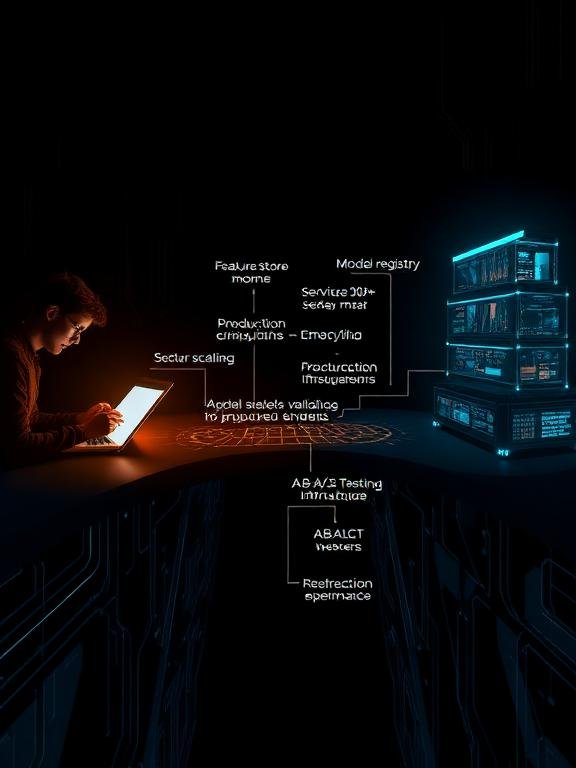
Production AI Platforms
The infrastructure that separates AI experiments from AI products. Production-grade MLOps platforms that let your data science team ship models reliably, repeatedly, and at scale.
From notebooks to production at scale
An enterprise AI platform is a production-grade infrastructure that provides end-to-end MLOps automation including experiment tracking, feature stores, model registries, serving infrastructure, and monitoring — enabling data science teams to deploy, manage, and scale ML models reliably across the organization.
Data science teams build amazing models in notebooks. Then they wait 6 months for engineering to productionize them — if it ever happens. The gap between experimentation and production is where AI initiatives die. Our Enterprise AI Platform closes that gap with self-service infrastructure. Feature stores eliminate duplicate computation, model registries enforce governance, and serving infrastructure handles 100K+ predictions per second.
Built on proven open-source foundations (MLflow, Feast, Seldon, KServe) with enterprise hardening — or native cloud platforms (SageMaker, Vertex AI, Azure ML). We match the architecture to your team and scale.
Everything your AI team needs to ship
Modular platform components that integrate into a cohesive production AI environment.
MLOps Platform
End-to-end pipelines from data ingestion through model training, validation, and deployment. Automated retraining, A/B testing, and canary deployments built in.
Feature Store
Centralized feature computation and serving for both batch and real-time use cases. Eliminates feature duplication, ensures consistency between training and inference.
Model Registry
Versioned model storage with lineage tracking, approval workflows, and automated compliance checks. Know exactly which model is serving which endpoint at all times.
Experiment Tracking
Structured experiment management with parameter logging, metric comparison, and artifact storage. Reproduce any experiment from any point in time with one click.
Serving Infrastructure
Auto-scaling model serving with GPU optimization, request batching, and multi-model endpoints. Handle traffic spikes without manual intervention or over-provisioning.
AI Governance
Model cards, bias detection, explainability reports, and audit trails. Meet regulatory requirements while enabling innovation velocity across your data science team.
Platform delivery in phases
Start with the highest-impact components and expand as your AI practice matures.
Maturity Assessment
Evaluate your current ML workflow, team capabilities, and infrastructure. Identify the platform components that will unlock the most immediate value.
Foundation Layer
Deploy core infrastructure: experiment tracking, model registry, and basic CI/CD for ML. Your team starts shipping models reliably within weeks.
Feature Engineering
Implement feature store with initial feature sets. Centralize computation, eliminate training-serving skew, and enable feature reuse across models.
Production Serving
Scale model serving with auto-scaling inference endpoints, A/B testing, and monitoring. Handle production traffic reliably with observability built in.
Governance & Scale
Layer on model governance, bias detection, and compliance reporting. Establish organizational standards that scale with your growing AI practice.
Platform Impact
Frequently asked questions
An enterprise AI platform is a production-grade infrastructure that provides end-to-end MLOps automation including experiment tracking, feature stores, model registries, serving infrastructure, and monitoring — enabling data science teams to deploy, manage, and scale ML models reliably across the organization.
MLOps (Machine Learning Operations) is the set of practices that automate and streamline the ML lifecycle from experimentation to production deployment. It matters because without MLOps, models remain stuck in notebooks — only 20% of ML projects ever reach production. MLOps provides automated pipelines, version control, monitoring, and governance that make AI deployment repeatable and reliable.
A production ML infrastructure includes six core components: experiment tracking for reproducible research, a feature store for centralized feature computation and serving, a model registry for versioned model management with governance, serving infrastructure for auto-scaling inference endpoints, monitoring for drift detection and performance tracking, and CI/CD pipelines for automated model deployment.
The build vs buy decision depends on team maturity, scale, and specific requirements. Organizations with 5+ data scientists and custom infrastructure needs benefit from building on open-source foundations (MLflow, Feast, KServe). Teams wanting faster time-to-value with managed services benefit from cloud-native platforms (SageMaker, Vertex AI, Azure ML). Hybrid approaches that combine both are increasingly common.
A phased enterprise AI platform build typically takes 8–16 weeks for core infrastructure (experiment tracking, model registry, basic serving) with additional phases for feature stores, advanced governance, and scaling. Using pre-built accelerators and proven reference architectures reduces this by 50–60% compared to building from scratch.
Ready to productionize your AI?
Tell us about your ML team and current workflow. We'll design a platform that fits your scale and maturity — then build it in weeks.