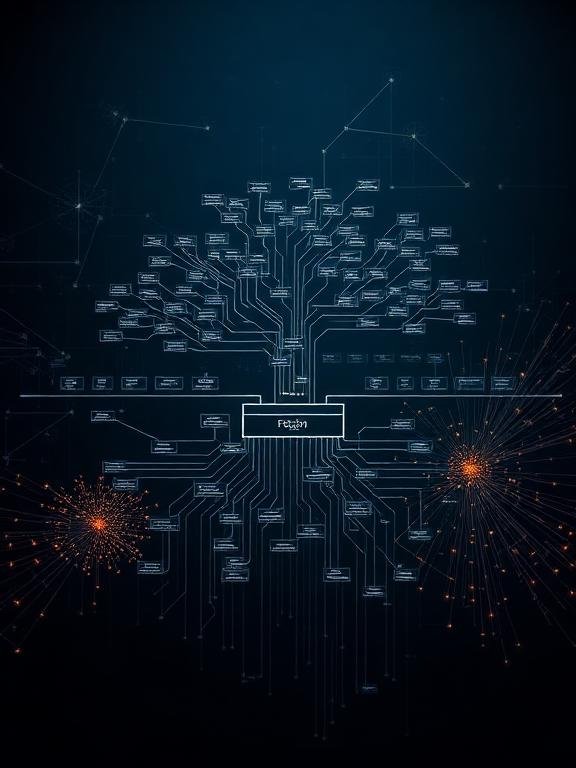
Semantic intelligence for the AI-first enterprise
Ontology-powered knowledge graphs, semantic layers, and OSI-compliant metadata that give AI agents the structured context they need to reason, not just retrieve.
The missing layer between data and AI
Semantic intelligence is the practice of encoding business meaning, relationships, and context into machine-readable structures — including ontologies, knowledge graphs, and semantic layers — that enable AI systems to reason about enterprise data with human-like understanding. Without this structured context, RAG retrieves text but AI agents cannot reason about entity relationships, enforce business rules, or maintain consistency across domains.
Our platform combines ontology engineering, enterprise knowledge graphs, and OSI-compliant semantic layers into a unified intelligence fabric. The result: AI that understands your business structure, not just your documents.
Built on the Open Semantic Interchange (OSI) specification — the vendor-neutral standard led by Snowflake, Salesforce, dbt Labs, and RelationalAI. Your semantic metadata works across every tool in your stack without translation layers.
Enterprise semantic intelligence stack
From ontology design to production knowledge graph — every component of semantic AI infrastructure.
Ontology Engineering
Domain-specific ontology design using OWL, SKOS, and SHACL. Business concept modeling, relationship taxonomies, and inference rules that encode your enterprise logic into machine-readable form.
Enterprise Knowledge Graph
Production-scale knowledge graphs on Neo4j, Amazon Neptune, and Azure Cosmos DB. Entity resolution, relationship extraction, and continuous graph enrichment from structured and unstructured sources.
Semantic Layer (OSI)
Open Semantic Interchange compliant metric definitions, dimensions, and business logic. Vendor-neutral semantic metadata that works across Snowflake, Databricks, dbt, and every BI tool in your stack.
GraphRAG & Reasoning
Retrieval-augmented generation powered by knowledge graph context. AI agents that traverse relationships, apply inference rules, and deliver explainable answers grounded in your enterprise ontology.
Simulation & Digital Twins
Ontology-driven simulation models that predict business outcomes before execution. What-if analysis, scenario planning, and digital twins powered by semantic relationships and causal reasoning.
Governance & Interoperability
Semantic versioning, ontology lifecycle management, and cross-domain alignment. FAIR principles (Findable, Accessible, Interoperable, Reusable) enforced across your entire knowledge architecture.
From raw data to semantic intelligence
A structured approach to building enterprise semantic infrastructure that compounds in value over time.
Discover
Audit existing data models, glossaries, and metadata. Identify high-value domains for initial ontology. Map stakeholder needs for AI agents that require semantic context.
Model
Design domain ontologies, entity relationships, and business rules. Validate with domain experts. Align to industry standards (FIBO for finance, HL7 for healthcare, ACORD for insurance).
Build
Deploy knowledge graph infrastructure, implement entity resolution pipelines, and integrate source systems. Continuous graph enrichment from documents, APIs, and streaming data.
Connect
Expose semantic layer via OSI specification. Connect to BI tools, AI agents, and analytics platforms. Enable GraphRAG for contextual retrieval across your knowledge base.
Evolve
Ontology versioning, automated quality checks, and continuous enrichment. Measure semantic coverage and AI accuracy improvements. Expand to new domains iteratively.
Semantic Intelligence Impact
Frequently asked questions
Semantic intelligence is the practice of encoding business meaning, relationships, and context into machine-readable structures — including ontologies, knowledge graphs, and semantic layers — that enable AI systems to reason about enterprise data with human-like understanding. It bridges the gap between raw data and AI by providing structured context that allows agents to interpret meaning, not just retrieve text.
Knowledge graphs are data structures that represent entities and their relationships in a graph format, enabling machines to traverse connections and infer new knowledge. For enterprises, knowledge graphs unify siloed data, enable contextual AI retrieval (GraphRAG), automate entity resolution, and provide explainable answers grounded in verified business relationships rather than statistical guesses.
An ontology is a formal, machine-readable representation of concepts, categories, and relationships within a business domain. Using standards like OWL, SKOS, and SHACL, ontologies encode business rules, taxonomies, and inference logic that allow AI systems to reason about data consistently — ensuring that 'customer,' 'account,' and 'transaction' mean the same thing across every system and team.
Semantic intelligence improves AI accuracy by up to 3× by providing structured context that eliminates ambiguity. Instead of relying solely on text similarity (as basic RAG does), AI agents traverse knowledge graphs to understand entity relationships, apply business rules encoded in ontologies, and deliver answers grounded in verified enterprise logic rather than statistical pattern matching.
A semantic layer defines business metrics, dimensions, and calculation logic in a vendor-neutral format (like the OSI specification), providing consistent definitions across BI tools and analytics platforms. A knowledge graph represents entities and their relationships as a traversable network. They are complementary: the semantic layer standardizes 'what to measure' while the knowledge graph captures 'how things connect.'
Ready to build your semantic foundation?
From ontology engineering to production knowledge graphs — the infrastructure that gives your AI a structural advantage competitors cannot replicate.